
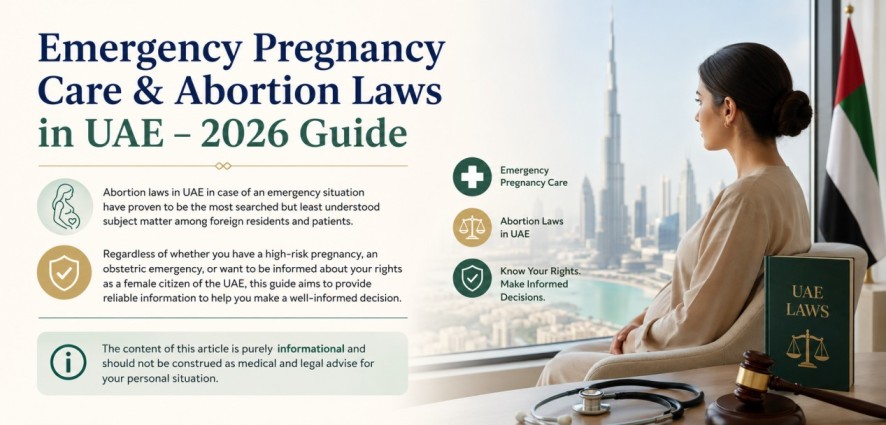
Abortion laws in UAE in case of an emergency situation have proven to be the most searched but least understood subject matter among foreign residents and patients. Regardless of whether you have a high-risk pregnancy, an obstetric emergency, or want to be informed about your rights as a female citizen of the UAE, this guide aims to provide reliable information to help you make a well-informed decision.
The content of this article is purely informational and should not be construed as medical and legal advise for your personal situation.
What Are the UAE Abortion Laws in 2026?
To understand UAE abortion laws in 2026, it is necessary to consider two legislative acts, namely Federal Law No. 2 of 2019 concerning the Use of Information Technology in the Health Field and the relevant sections of the Penal Code according to Federal Law No. 3 of 1987. It should be emphasized that abortions are legally regulated and considered illegal actions in the UAE.
It is noteworthy that the UAE legal system is based on Islamic Sharia and civil legislation, and therefore from the medical and legal point of view, the termination of pregnancy is permissible only when:
• The pregnancy is directly dangerous for the mother’s life or well-being.
• The child suffers from severe congenital defects incompatible with life.
• There is appropriate documentation signed by the doctor from a medical committee authorized to carry out such operations.
Abortion is considered illegal in other cases and is punished by imprisonment and monetary fines imposed on the participant of these actions.
When Does Medical Emergency Abortion UAE Become Lawful?
As already stated above, the cases of medical abortion in the UAE are thoroughly investigated and discussed by healthcare providers and lawmakers prior to the approval of abortion procedures. The point is, one should realize that in case of legitimate necessity, the decision on medical abortion will be made jointly with the participation of a multi-disciplinary team.
Legitimate Medical Conditions
According to the standards developed by the Ministry of Health & Prevention (MOHAP) and followed in UAE, the following situations can serve as legitimate medical reasons for termination of pregnancy:
• Ectopic pregnancy that poses a direct threat to the health and life of the pregnant woman.
• Hypertensive disorders of pregnancy, pre-eclampsia, and eclampsia.
• Defects in the developing fetus incompatible with its further survival.
• Septic miscarriage and inevitable miscarriage.
• Critical health status of the pregnant woman (such as cancer, serious heart disease, etc.)
For all of these cases, the attending obstetrician is responsible for documenting the clinical indications for this treatment, obtaining informed consent from the patient (and her husband or other person acting as legal guardian, in most cases), and the case will be considered by an ethics/medical committee prior to carrying out the treatment.
Pregnancy Complications Treatment UAE – Patient Rights
Treatment for pregnancy complications in UAE is provided by both public and private hospitals in Dubai. The law in the United Arab Emirates provides pregnant women (regardless of their citizenship) with the right to receive medical help in cases of emergencies.
Pregnancy Complications Treated in UAE Hospitals
• Gestational diabetes and its complications
• Placenta previa and placental abruption
• Pre-term labour and threat of miscarriage
• Hyperemesis gravidarum (severe pregnancy vomiting)
• DVT in pregnancy
• Intrauterine growth restriction (IUGR)
• Postpartum hemorrhage (PPH)
Emergency pregnancy care UAE is available in major hospitals’ emergency departments on a 24-hour basis. You are entitled to receive stabilizing treatments in accordance with the UAE laws regarding medical emergencies. In addition, your privacy rights will be respected in accordance with the UAE patient rights rules.
Reproductive Health Laws UAE – Legal Framework
Reproductive health laws UAE consists of various laws relating to contraception, pregnancy, maternity and obstetric emergencies. Some of the important legal documents are listed below in order to give an overview of the laws:
Federal Law No. 2 of 2019 – Health Information Technology Federal Law No. 3 of 1987 – UAE Penal Code (abortion) Federal Law No. 10 of 2008 – Medical Liability Ministerial Resolution No. 32 of 1975 – Practicing Profession of Medicine HAAD Abu Dhabi Regulations Clinical Guidelines from Dubai Health Authority (DHA) MOHAP Reproductive Health Guidelines 2023 |
According to Federal Law No. 10 of 2008 Medical Liability, all healthcare professionals working in the UAE have a legal duty to provide treatment for patients in cases of emergencies that endanger their lives irrespective of their financial status or citizenship.
UAE Healthcare Laws for Pregnant Women – What You Should Know
Getting through UAE healthcare laws for pregnant women can be daunting, particularly for foreigners. Below is what you should know according to UAE laws:
Antenatal Care
It is mandatory for all licensed healthcare centers to offer antenatal care services that include appointment bookings, blood testings, ultrasonography scanning, GDM testing, and Group B Streptococcus (GBS).
Rights of Maternity Leave
According to Federal Decree-Law No. 33 of 2021 (UAE Labour Law), female workers from the private sector are eligible to 60 days of paid maternity leave which consists of 45 days at full pay and 15 days at half pay while females in the public sector are eligible to 90 days of maternity leave.
Informed Consent and Patient Confidentiality
Every female patient should be informed and given their consent regarding every healthcare process such as surgery conducted during pregnancy according to UAE laws. Patients are entitled to confidentiality when it comes to their health records.
Confidential Women’s Healthcare UAE – Preserve Your Privacy
One of the top concerns faced by women looking for reproductive healthcare in the UAE is confidentiality. However, it is great to learn that women have confidential women’s healthcare UAE as their right. Both MOHAP and DHA policies mandate healthcare service providers to respect patient privacy in the absence of any legal reason to breach confidentiality such as criminal investigations or disease reporting.
Expat women should know that they do not have anything to worry about if they find themselves in need of emergency pregnancy care UAE due to miscarriage, ectopic pregnancy, or any other kind of obstetric emergency. Patient confidentiality remains sacrosanct for medical professionals, and so do medical ethics codes.
Nevertheless, in case an expectant woman goes into a hospital after an illegal abortion that results in complications, she risks having her case reported to the authorities by the medical team dealing with her problem. This is why this guide highly recommends to consult legal and certified medical facilities only from the very beginning.
UAE Gynecological Emergencies – Sources of Treatment
The UAE gynecology emergency services can be availed from all big hospitals in Abu Dhabi, Dubai, Sharjah, and elsewhere in UAE. The following is an indicative list of the trusted and government recognized agencies providing reproductive and maternal services in UAE:
Government Health Departments
• Ministry of Health and Prevention (MOHAP) – mohap.gov.ae
• Abu Dhabi Health Services Company (SEHA) – seha.ae
• Dubai Health Authority (DHA) – dha.gov.ae
• Sharjah Health Authority (SHA) – sha.sharjah.gov.ae
• Ajman Health Department – ajmanhd.gov.ae
Maternity and Gynecology Emergency Treatment Centres
• Corniche Hospital, Abu Dhabi – Maternity Centre and High Risk Obstetric Centre operated by SEHA.
• Sheikh Khalifa Medical City (SKMC), Abu Dhabi – Governmental hospital that provides maternal fetal medicine unit.
• Latifa Hospital for Women and Children, Dubai – Specialized women and children hospital managed by DHA.
• Rashid Hospital, Dubai – Government hospital providing obstetric emergency services 24/7.
• Al Zahra Hospital, Dubai & Sharjah: Private hospital providing services for emergencies related to gynecology and obstetrics
• Saudi German Hospital, Dubai – Private facility that provides services of women’s health and obstetrics.
• Mediclinic Middle East – Network of hospitals providing OB-GYN emergency services.
• Aster Hospitals UAE – Popular private hospital providing around the clock women’s health care.
• Burjeel Hospital, Abu Dhabi – Private hospital providing maternal health care services.
Emergency Numbers
Emergency Numbers National Emergency Number (Police / Ambulance): 999 Dubai Health Authority Helpline: 800-342 MOHAP Health Call Centre: 80011111 SEHA Patient Services (Abu Dhabi): 800-50 Rashid Hospital Emergency (Dubai): +971-4-219-2000 Corniche Hospital (Abu Dhabi): +971-2-672-3200 Dr. Marry Abortion Specialist: Website and WhatsApp: +966542403006 |
Maternal Health Services UAE – Continuum of Care Approach
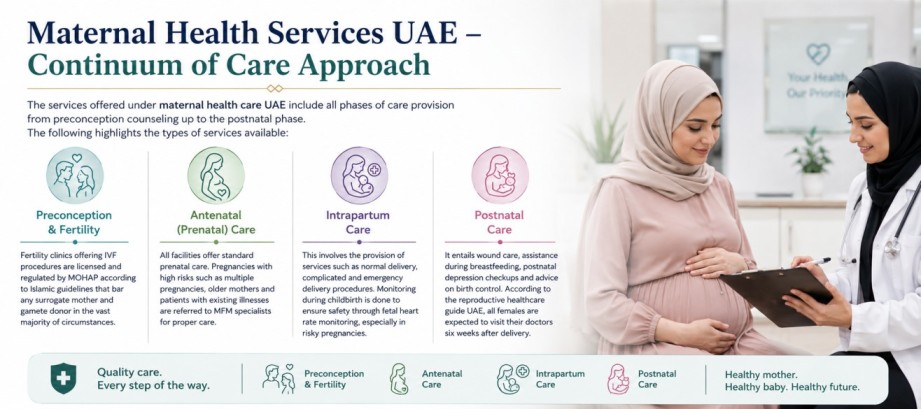
The services offered under maternal health care UAE include all phases of care provision from preconception counseling up to the postnatal phase. The following highlights the types of services available:
Preconception & Fertility
Fertility clinics offering IVF procedures are licensed and regulated by MOHAP according to Islamic guidelines that bar any surrogate mother and gamete donor in the vast majority of circumstances.
Antenatal (Prenatal) Care
All facilities offer standard prenatal care. Pregnancies with high risks such as multiple pregnancies, older mothers and patients with existing illnesses are referred to MFM specialists for proper care.
Intrapartum Care
This involves the provision of services such as normal delivery, complicated and emergency delivery procedures. Monitoring during childbirth is done to ensure safety through fetal heart rate monitoring, especially in risky pregnancies.
Postnatal Care
It entails wound care, assistance during breastfeeding, postnatal depression checkups and advice on birth control. According to the reproductive healthcare guide UAE, all females are expected to visit their doctors six weeks after delivery.
UAE Women’s Health Services – Tips for Expat Females
The women’s health services in UAE are well-developed, internationally accredited, and even have laws regulating how the health services must be provided to protect the patients. Here are some important things to know about women’s health services in UAE:
• Make sure your health insurance is covering all costs related to emergencies in gynaecology and obstetrics, which is required by law in Dubai and Abu Dhabi, for those who work here.
• In case of unintended pregnancy, you need to receive medical advice from an expert doctor without disclosing anything to anyone else.
• Do not try to obtain any medication for a home abortion as this is against the law.
• In case of any problems related to pregnancy complications, such as vomiting, high body temperature, fainting, and heavy menstrual bleeding, visit a hospital urgently.
• Cases where legal abortion takes place are extremely rare.
Frequently Asked Questions (FAQ)
Q1: Strict emergency abortion law in UAE?
Yes. Emergency abortion law in UAE is very strict. It can only be performed in cases where there is serious threat to life caused by either maternal condition or serious fetal abnormality that makes survival impossible; this is sanctioned by licensed medical committee. Any elective abortion is against law.
Q2: Can I receive emergency pregnancy care in UAE?
Yes, definitely. By virtue of Federal Law Number 10 of 2008, emergency obstetric care services are required to be available in all licensed hospitals within the UAE irrespective of nationalities and insurance covers.
Q3: Legal cases of abortion UAE
Legal abortion cases UAE include: ectopic pregnancy, life threatening maternal illness, or fetal abnormalities incompatible with life – all verified by licensed medical committee in any of the licensed hospitals within UAE.
Q4: Different abortion laws UAE Emirates?
The major law that governs abortion is applicable across UAE. Nonetheless, Abu Dhabi (HAAD/SEHA), Dubai (DHA), and others may have their own guidelines in terms of clinical practice. Federal Law Number 3 of 1987 & MOHAP guidelines still apply everywhere in the UAE.
Q5: Is my medical information confidential in UAE?
Yes. Medical confidentiality is a key part of UAE patient rights law. Without your consent, your personal health information can’t be disclosed, unless required by law.
Q6: Where is UAE gynecology emergency services?
In UAE, gynecology emergency services are provided in Corniche Hospital (Abu Dhabi), Latifa Hospital (Dubai), Rashid Hospital (Dubai), SKMC, and all other main private hospitals such as Mediclinic, Aster, and Burjeel. In case of an emergency, dial 999.
Q7: Is maternal health UAE available to expat women?
Yes. The health services for mothers in UAE, including ante-natal care, childbirth, and maternity emergencies, are available to all residents and tourists. Maternity insurance is mandatory for working residents in Dubai and Abu Dhabi.
Q8: What are the safe reproductive health guidelines in UAE?
The reproductive healthcare guidelines in UAE include: getting registered with a licenced OB-GYN early in pregnancy, attending all antenatal consultations, contacting the hospital emergency department at any sign of complication, and consulting only licenced physicians for all decisions about reproductive health.
Q9: What happens if there is miscarriage in UAE?
Miscarriage, whether it is missed or spontaneous, is regarded as a medical issue in UAE, and all patients are entitled to proper treatment through hospitals including surgical operation if necessary. This is a legal act in the UAE and does not require any criminal investigations.
Q10: Is there any crisis helpline in UAE for pregnancies?
Yes. MOHAP Health Call Centre: 80011111. DHA Helpline: 800-342. SEHA (Abu Dhabi): 800-50. Physical emergencies should be contacted by 999. Social workers in Latifa and Corniche hospitals may be contacted for psychological help.
Conclusion – Know Your Rights, Get Proper Care
As discussed above, there is an existing law in UAE that provides information about emergency abortion in the country. The law respects the right to life of a woman, ensuring access to proper treatment by protecting her from any harm caused due to the process of abortion. In case you or anyone around you is having complications during pregnancy or a medical condition related to the reproductive health problem in UAE, then the very first thing you should do is contact a professional doctor in a reputed hospital.
Avoid going for unregistered doctors, medications, or any other illegal source. The medical services in UAE hospitals are internationally recognized and provide all the necessary services to each patient in emergencies. For further guidance, you can consult a doctor specializing in obstetrics and gynecology or a lawyer in UAE reproductive law. We will be happy to help. Contact us Dr. Marry For visit website or call: +966542403006
Disclaimer – Medical & Legal
The content in this article is written only to provide education and information. The data stated here is based on UAE laws and regulations regarding healthcare up until 2026. This article does not provide any medical or legal advice. Laws are subject to change and updates; hence, make sure to check your relevant department/authority/legal professionals for the latest updates.