
Introduction
For women facing an unexpected or complex pregnancy, questions surrounding abortion pills in Saudi Arabia can be personal – and sometimes fearful, confused and in need of reliable information. This article is not intended to be judgmental or disrespectful to women’s circumstances. It is meant to be informative only: to detail what medical abortion is, the legalities surrounding medical abortion in Saudi Arabia, and what every woman should know about safety.
If you or a friend is facing a pregnancy decision, the best thing to do is seek out a trained medical professional who is licensed to provide safe, confidential and medically accurate information.
IMPORTANT DISCLAIMER
This article provides general information and education. It is not intended to be a substitute for professional medical advice, diagnosis or treatment. It is not a substitute for personalized medical advice, diagnosis or treatment.
What Is a Medical Abortion?
A medical abortion (also known as a medicine abortion or abortion pill) is the termination of a pregnancy through the administration of certain drugs. A medical abortion is safe and effective, according to the World Health Organization (WHO), when done with medical supervision and during the correct stage of pregnancy.
Medical abortion involves either one or two drugs:
• Mifepristone – blocks a hormone needed to sustain pregnancy.
• Misoprostol – causes the pregnancy to be expelled.
These medications should only be taken under medical supervision. Using them outside of medical care can cause heavy bleeding, infection and an incomplete abortion, which may need to be treated in hospital.
Abortion laws in Saudi Arabia
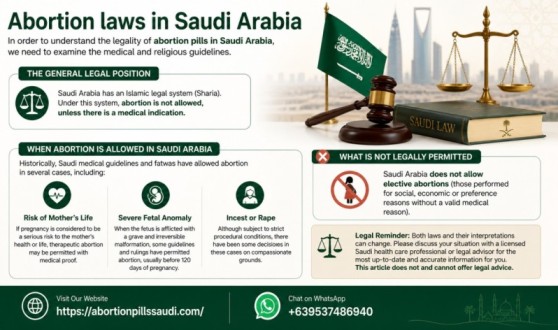
In order to understand the legality of abortion pills in Saudi Arabia, we need to examine the medical and religious guidelines.
The General Legal Position
Saudi Arabia has an Islamic legal system (Sharia). Under this system, abortion is not allowed, unless there is a medical indication.
When Abortion is Allowed in Saudi Arabia
Historically, Saudi medical guidelines and fatwas have allowed abortion in several cases, including:
• Risk of mother’s life: If pregnancy is considered to be a serious risk to the mother’s health or life, therapeutic abortion may be
permitted with medical proof.
• Severe fetal anomaly: When the fetus is afflicted with a grave and irreversible malformation, some guidelines and rulings have
permitted abortion, usually before 120 days of pregnancy.
• Incest or rape: Although subject to strict procedural conditions, there have been some decisions in these cases on
compassionate grounds.
What Is Not Legally Permitted
Saudi Arabia does not allow elective abortions (those performed for social, economic or preference reasons without a valid medical reason).
Legal Reminder: Both laws and their interpretations can change. Please discuss your situation with a licensed Saudi health care professional or legal advisor for the most up-to-date and accurate information for you. This article does not and cannot offer legal advice..
Why Women Are Looking For Abortion Pills
There are numerous reasons why women in Saudi Arabia and throughout the Arab world are searching for information on abortion pills:
• Unwanted pregnancy following birth control failure
• Severe medical condition during pregnancy
• Concerns about fetal development
• Psychological distress and lack of support
• Concern about judgement or stigma
These are human experiences, and they should be treated with empathy and non-judgement. Regardless of why a woman is looking for information, she must be safe.
What women need to know about medical safety
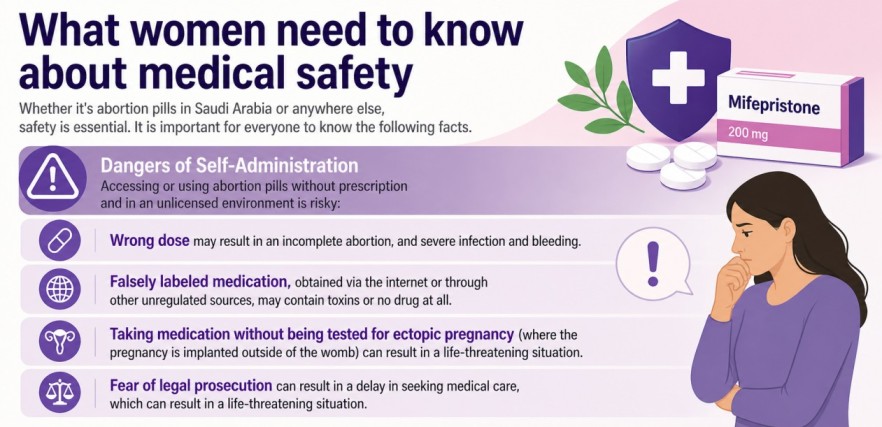
Whether it’s abortion pills in Saudi Arabia or anywhere else, safety is essential. It is important for everyone to know the following facts.
Dangers of Self-Administration
Accessing or using abortion pills without prescription and in an unlicensed environment is risky:
• Wrong dose may result in an incomplete abortion, and severe infection and bleeding.
• Falsely labeled medication, obtained via the internet or through other unregulated sources, may contain toxins or no drug at all.
• Taking medication without being tested for ectopic pregnancy (where the pregnancy is implanted outside of the womb) can
result in a life-threatening situation.
• Fear of legal prosecution can result in a delay in seeking medical care, which can result in a life-threatening situation.
Emergency Warning Signs – Go to the ER
If you have any of the following symptoms, please visit your local emergency department:
• Heavy or prolonged bleeding (more than two heavy pads/hour for two or more hours)
• Severe pain or cramping not treated with pain relief
• High fever (above 38°C / 100.4°F) lasting more than 24 hours
• Foul-smelling vaginal discharge
• Feeling dizzy, faint or in shock
• No bleeding for 24 hours after medication
You should never be afraid to seek medical attention. Health care workers have professional ethics to care for their patients.
The Role of Licensed Healthcare Providers
The best course of action for any woman in Saudi Arabia who is concerned about her pregnancy is to seek out a licensed health care provider. Licensed healthcare providers can:
• Confirm pregnancy and determine how far along the pregnancy is via ultrasound
• Diagnose complications such as ectopic pregnancy
• Discuss the available pregnancy options within the law
• Offer information about specialists or counsellors
• Ensure any medical procedure is safe and well monitored
Need guidance? Talk to a health professional in confidence.
Saudi Arabia’s Reproductive and Women’s Health
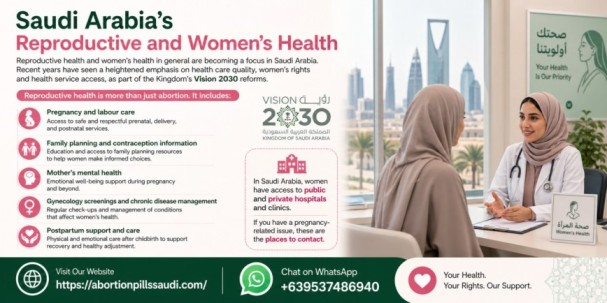
Reproductive health and women’s health in general are becoming a focus in Saudi Arabia. Recent years have seen a heightened emphasis on health care quality, women’s rights and health service access, as part of the Kingdom’s Vision 2030 reforms.
Reproductive health is more than just abortion. It includes:
• Pregnancy and labour care
• Family planning and contraception information
• Mother’s mental health
• Gynecology screenings and chronic disease management
• Postpartum support and care
In Saudi Arabia women have access to public and private hospitals and clinics. If you have a pregnancy-related issue, these are the places to contact.
Emotional and Psychological Support
Unexpected pregnancy and complex medical pregnancy issues can be emotionally difficult. It is normal to feel fear, shame, confusion and grief.
Psychological support is available through:
• Hospital-based counseling services
• Private therapists and psychiatrists
• Support from trusted community organisations
• Online emotional supports from trained professionals
Women should never have to go through this alone. It’s brave to seek and find emotional support.
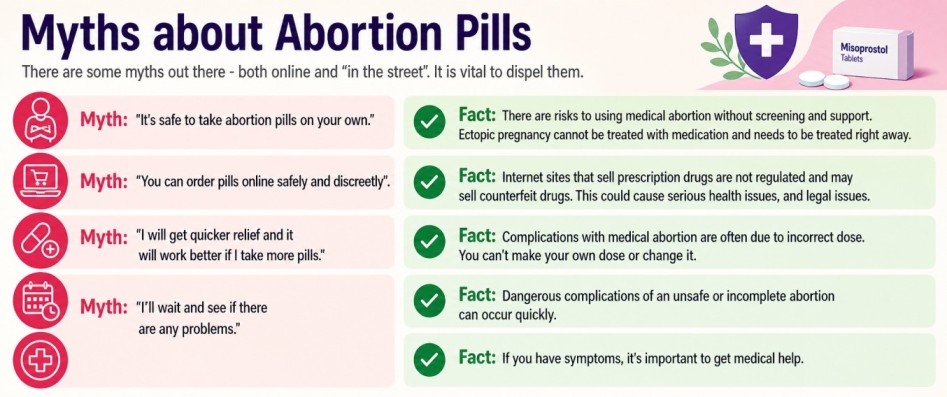
Myths about Abortion Pills
There are some myths out there – both online and “in the street”. It is vital to dispel them.
Myth: “It’s safe to take abortion pills on your own.”
Fact: There are risks to using medical abortion without screening and support. Ectopic pregnancy cannot be treated with medication and needs to be treated right away.
Fact: “You can order pills online safely and discreetly”.
Fact: Internet sites that sell prescription drugs are not regulated and may sell counterfeit drugs. This could cause serious health issues, and legal issues.
Myth: “I will get quicker relief and it will work better if I take more pills.”
Fact: Complications with medical abortion are often due to incorrect dose. You can’t make your own dose or change it.
Myth: “I’ll wait and see if there are any problems.”
Fact: Dangerous complications of an unsafe or incomplete abortion can occur quickly. If you have symptoms, it’s important to get medical help.
What are the options?
In Saudi Arabia, women facing an unwanted pregnancy have a number of options:
• Continue the pregnancy with antenatal care: Saudi health care facilities offer antenatal care.
• Kafala (legal guardianship): Though the legal system for adoption is different from the West, kafala is an established option for vulnerable children.
• Therapeutic abortion (if legal): For pregnancies where there is a documented medical risk to the mother or severe fetal anomaly, a consultation with a medical practitioner and documentation of the medical indication is required.
All these should be considered with the help of a health professional and, if necessary, a counselor.
Frequently Asked Questions (FAQs)
1. Is it legal to take abortion pills in Saudi Arabia?
Abortion drugs are not widely available in Saudi Arabia. This may be allowed under certain, well-documented medical reasons, such as substantial risk to the mother’s life and health, or severe malformation of the fetus, provided it is performed by qualified doctors in accordance with Saudi medical and religious authorities’ guidelines. It is illegal in Saudi Arabia to have an elective abortion.
2. Is it safe to take abortion pills without a doctor in Saudi?
No. Self-administration of the abortion pills anywhere is unsafe. If you’re not sure where the pregnancy is (to exclude ectopic pregnancy), you haven’t had the right tests and don’t have someone watching you after taking the pills, you risk serious complications, including death.
3. What are the complications of abortion pills?
These include severe vaginal bleeding, severe abdominal pain, fever (38°C or more) that lasts more than 24 hours, foul-smelling vaginal discharge or no bleeding within 24 hours. These need urgent medical attention.
4. Are there safe reproductive health services in Saudi Arabia?
In the major cities (Riyadh, Jeddah and Dammam), there are government and private hospitals and women’s clinics. If you have questions about pregnancy, see your general practitioner or a qualified obstetrician and gynecologist (OB-GYN).
5. If I get an unwanted pregnancy in Saudi Arabia?
You should see a health care provider immediately. This will ensure you receive the health care you need, information about your choices (including legal choices) and support.
6. I am 2 months pregnant, but I don’t want to have the baby?
At 8 weeks, see a doctor about it. You may be able to have a medical abortion, depending on your health status, pregnancy status, and Saudi abortion laws. Don’t take abortion pills alone.
7. How many days can a pregnancy be terminated?
Termination of pregnancy varies by health, pregnancy duration and law. Abortion pills are generally used in early pregnancy, typically up to 10 weeks with medical supervision.
8. Is abortion banned in Saudi Arabia?
Abortion is not totally prohibited but heavily regulated. It can be permitted only under certain medical conditions such as risk to the mother’s health or malformations of the fetus.
9. How far along can I be to have the abortion pill?
The abortion pill works best in the first 10 weeks of pregnancy. After 10 weeks the risks associated with abortion increase, and it becomes even more critical to receive medical supervision.
10. What is the abortion law in Saudi Arabia?
Saudi Arabia has strict abortion laws, and usually only permits abortion for medical reasons. A doctor’s approval and hospital and medical reports is usually required to make the abortion legal.
11. When can you abort in Islam?
Islamic scholars often refer to 120 days. Up to that time, abortion can be used only for important reasons. Beyond that, it’s more limited.
Conclusion
Abortion pills in Saudi Arabia are a complex issue that touches on health, religion, law and people’s lives. We have strived to present accurate, empathetic and safety-focused information in this article to assist women with their decision making, and, most importantly, their safety.
The most important takeaway from this article is this: never try to get or use abortion pills without the guidance of a medical professional.
Medical Disclaimer
This article is for informational and educational purposes only. It is not intended to be a substitute for professional medical advice, diagnosis or treatment. Reproductive health laws can differ and are subject to change. We encourage readers to seek the advice of a qualified health care provider, and to check the laws in their jurisdiction. The publisher does not support or engage in any activity that is illegal.
Sources cited: World Health Organization (WHO) standards on safe abortion, fatwas on pregnancy published by the Saudi Council of Senior Scholars and international standards for reproductive health.
One Response