
Introduction
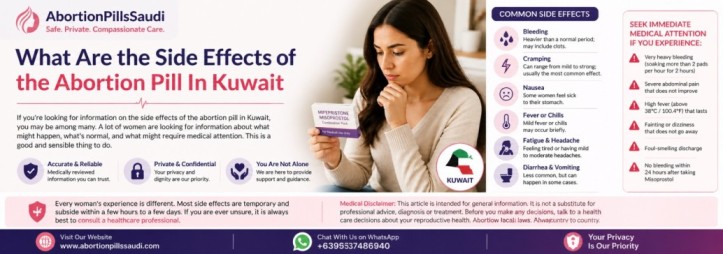
If you’re looking for information on the side effects of the abortion pill in Kuwait, you may be among many. A lot of women are looking for information about what might happen, what’s normal, and what might require medical attention. This is a good and sensible thing to do.
This article contains accurate, reliable and medically-based information on abortion pills, side effects and safety. We also want you to feel empowered, confident, and never judged.
Whether you’re gathering information or considering your options, it’s important to read reliable information.
Medical Disclaimer: This article is intended for general information. It is not a substitute for professional advice, diagnosis or treatment. Before you make any decisions, talk to a health care decisions about your reproductive health. Abortion laws differ from country to country. Always follow local laws.
What Are Abortion Pills?
Abortion pills are drugs that can be used to terminate an early pregnancy. They are approved by the World Health Organization (WHO) as a safe and effective method of pregnancy termination if taken correctly and under medical supervision.
This is the most popular type of medical abortion, which involves taking two drugs in sequence:
• Mifepristone: This drug blocks a hormone called progesterone that is needed to sustain a pregnancy. When this hormone is
blocked, the pregnancy can’t go on.
• Misoprostol: This medicine is taken 24 to 48 hours later. This makes the uterus contract and the pregnancy be expelled, like a
miscarriage.
These two drugs are one of the safest ways of terminating a pregnancy in the early stages (10-13 weeks) when administered under the supervision of licensed medical professionals.
The Most Common Way of Use (General Medical Review)
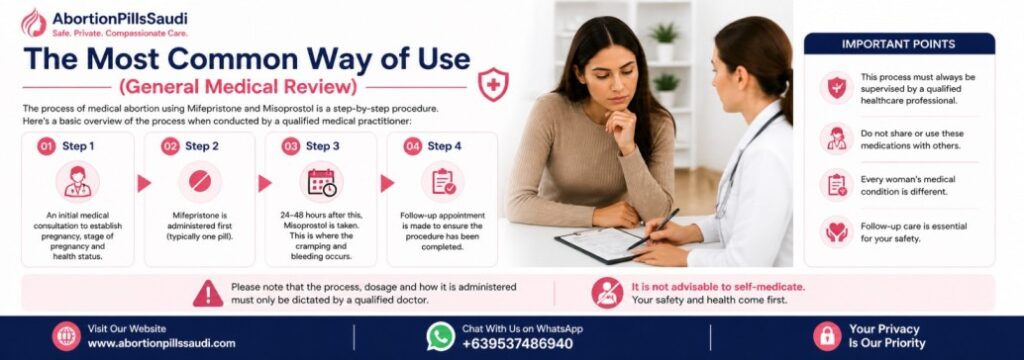
The process of medical abortion using Mifepristone and Misoprostol is a step-by-step procedure. Here’s a basic overview of the process when conducted by a qualified medical practitioner:
• Step 1: An initial medical consultation to establish pregnancy, stage of pregnancy and health status.
• Step 2: Mifepristone is administered first (typically one pill).
• Step 3: 24-48 hours after this, Misoprostol is taken. This is where the cramping and bleeding occurs.
• Step 4: Follow-up appointment is made to ensure the procedure has been completed.
Please note that the process, dosage and how it is administered must only be dictated by a qualified doctor. It is not advisable to self-medicate.
Laws and Regulations in Kuwait
It’s crucial to be aware of the laws before deciding on any issues related to reproductive health in Kuwait.
Abortion is generally illegal in Kuwait. Abortion is generally outlawed by the Kuwaiti Penal Code. There may be exceptions in rare medical cases, such as a risk to the mother’s life.
This means that accessing abortion pills and abortion services in Kuwait requires knowledge of the laws. We recommend all women in Kuwait to:
• Speak with a qualified health practitioner.
• Be aware of the current legislation and status in Kuwait for reproductive health.
• Consult a local medical doctor regarding legal issues.
This article does not promote illegal behaviours. It is not intended to encourage illegal activities. Please consult with a local, licensed medical practitioner or lawyer for the latest information and advice.
Safety Considerations
Reproductive health is important, and safety is a priority. If you are looking for information on, or considering a medical abortion, here are some safety considerations:
Only Use Quality Medications
Fake or substandard medicines can be harmful. Don’t buy medications from unknown sources or online. And make sure the medication is from a reliable source.
Medical Supervision Is Essential
It’s essential the abortion pill procedure is supervised by a medical practitioner. This check includes establishing the pregnancy is there, whether you have an ectopic pregnancy (a life-threatening condition), and whether you are a good fit for medical abortion.
Ectopic Pregnancy Warning
If you have an ectopic pregnancy (this is when the pregnancy is not inside the uterus) the abortion pills will not work and can kill you. This is one of the reasons why it is imperative to see a doctor before taking abortion pills.
Follow Step-by-Step Medical Guidance
Even with authentic medication, if you don’t use it properly, it may not work or cause complications. Be sure to follow the instructions of your medical provider.
Side Effects and Signs of Complications In Kuwait
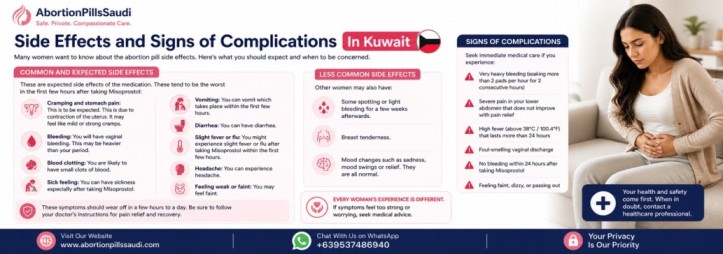
Many women want to know about the abortion pill side effects. Here’s what you should expect and when to be concerned.
Common and Expected Side Effects
These are expected side effects of the medication. These tend to be the worst in the first few hours after taking Misoprostol:
• Cramping and stomach pain: This is to be expected. This is due to contraction of the uterus. It may feel like mild or strong
cramps.
• Bleeding: You will have vaginal bleeding. This may be heavier than your period.
• Blood clotting: You are likely to have small clots of blood.
• Sick feeling: You can have sickness especially after taking Misoprostol.
• Vomiting: You can vomit which takes place within the first few hours.
• Diarrhea: You can have diarrhea.
• Slight fever or flu: You might experience slight fever or flu after taking Misoprostol within the first few hours.
• Headache: You can experience headache.
• Feeling weak or faint: You may feel faint.
These symptoms should wear off in a few hours to a day. Be sure to follow your doctor’s instructions for pain relief and recovery.
Less Common Side Effects
Other women may also have:
• Some spotting or light bleeding for a few weeks afterwards.
• Breast tenderness.
• Mood changes such as sadness, mood swings or relief. They are all
normal.
When to Call the Doctor
Most side effects are normal but some symptoms may be a sign of a serious complication and need urgent medical care. Never ignore these symptoms:
• Heavy bleeding: Passing more than two thick sanitary pads an hour for two or more hours in a row is heavy bleeding that
needs immediate medical attention.
• Fever: A fever of more than 38 degrees Celsius (100.4 Fahrenheit) and continues for more than 24 hours could be a sign of
infection.
• Very bad abdominal pain: Pain that is worse with painkillers and is very severe might need urgent attention.
• Bad-smelling discharge: This may be a sign of infection.
• No vaginal bleeding: If you take Misoprostol and do not experience bleeding, it may be a sign that the medication has not been
effective and you should seek medical attention.
• Allergic reactions: If you feel you’re having trouble breathing, the face is swollen or you have a rash, you may be having an
allergic reaction and need medical attention.
If you have any of the above symptoms, call an ambulance immediately. Do not wait.
Note: Need guidance? Speak to your doctor confidentially. We want you to be safe.
Here’s How to Talk to a Licensed Doctor
It is not only recommended, but essential to your health to talk to a doctor before and after a medical abortion. Here are some tips:
• Tell your doctor about other conditions: If you have any other medical conditions, allergies or medication, tell your doctor.
This will help them advise you.
• Ask about a test for ectopic pregnancy: Make sure your doctor does a test to ensure it is in the uterus and not the fallopian
tube.
• Ask about what to expect: Ensure you ask your healthcare provider about how much bleeding, cramping and recovery is
normal.
• Ask about follow-up: You will need to make an appointment for follow-up to check it is complete and you are okay.
• Ask to speak in private: If you’re speaking to a health care provider via phone, make sure you’re speaking privately and
confidentially.
If you’re looking for a confidential and compassionate medical consultation, Abortion Saudi can put you in touch with Dr. Mary: a health care professional who is a caring doctor and expert in women’s reproductive health. She can provide confidential support and advice in a non-judgemental way.

Privacy and Confidential Support Options
We know privacy is an important concern for women looking for information on reproductive health, especially in a country such as Kuwait.
Here are some tips for privacy when seeking information or support:
• Use an anonymous browser when searching for information online.
• Use encrypted messaging apps if consulting with a health provider online.
• Take care to only share information with trusted sources.
• Make sure any provider you see has a privacy statement and is committed to confidentiality.
Abortion Saudi guarantees confidentiality. Dr. Mary’s consultations are confidential and private. We do not share your personal information and our consultations are confidential.
If you’re concerned about privacy in your area, please speak to a local licensed health care provider, or consult reputable women’s health organisations that operate confidentially in your area.
FAQs
1. What are the side effects of the abortion pill?
Among the commonly experienced side effects of the pill include cramps, vaginal bleeding, nausea, vomiting, diarrhea, fever, and chills. All these side effects are normal, and you should expect them to disappear within several hours up to 24 hours after taking the pills.
2. What is the duration of the side effects of abortion pill?
The more severe side effects (particularly cramping and heavy bleeding) typically last a few hours after taking Misoprostol. Some light spotting may last for a further two to four weeks. In case of persisting side effects or their worsening, consult your physician.
3. Do I have any chances of developing fever due to consumption of the abortion pills?
It is very normal for a person to develop fever accompanied by chills a few hours after taking Misoprostol. In case you are suffering from high fever exceeding 38 degrees Celsius and is ongoing for more than 24 hours, it could mean you have an infection.
4. Will the abortion pill prevent me from getting pregnant?
Leading health bodies consider that good quality medical abortion does not interfere with fertility. Women can conceive within a few days of a medical abortion. Always speak to a doctor for medical advice about your fertility.
5. How do I tell that the pill is successful in aborting my pregnancy?
The two most prominent symptoms indicating success include heavy bleeding and cramping, accompanied by the lessening of pregnancy symptoms. The surest way to know whether or not the method was effective is to consult your healthcare professional at an abortion clinic or take a pregnancy test.
How Do I Know the Abortion Pill Has Worked?
The most obvious signs that an abortion pill has been successful are bleeding and cramping, which typically begin a few hours after taking the Misoprostol pill. This is because the embryo is being expelled from the womb. You might also pass blood clots, have disappearance or reduction in pregnancy symptoms (like nausea and tender breasts), and relief from pelvic pressure. It’s best to have a check-up with a health care provider to verify the abortion.
What Not to Do After Abortion Pills?
Following abortion pills, avoid strenuous activity for a brief period, keep anything from entering the vagina (such as tampons) until instructed by a health professional and avoid taking other medications. You should also avoid ignoring excessive bleeding, severe pain, fever or strange discharge, as you may require medical care for these. Take plenty of rest, fluids, and follow up as needed.
What Are the Side Effects of Misoprostol?
Misoprostol side effects include cramps, blood loss, nausea, vomiting, diarrhoea, fever, chills, fatigue and dizziness. These are generally short-lived side effects when the drug is working. A doctor or nurse should be consulted about severe pain or bleeding.
Can Misoprostol Harm the Uterus?
The use of misoprostol will not harm the uterus if it is used properly. The chances of having major health problems are uncommon, but they may be more likely if it is misused. This includes having excessive bleeding and incomplete abortions.
Conclusion
Being aware of the effects of taking the abortion pill in Kuwait is important for making wise decisions concerning your health. In this article, we examined the definition of the abortion pill, its mechanism, some potential side effects, when you should seek help and when emergency medical attention is required.
Your health, security and anonymity are our priorities.Regardless of your circumstances, you should have access to reliable information, support and medical care.
You should always talk to a licensed health-care provider before taking medicine. Obey the laws in your area, and speak with providers who will respect your privacy and preferences.
Need confidential guidance? Contact a health care provider today. You have the right to safe, non-judgmental and confidential reproductive health services.
Sources & References
• World Health Organization (WHO) – Medical Management of Abortion Guidelines
• American College of Obstetricians and Gynecologists (ACOG) – Medication Abortion Resources
• International Federation of Gynecology and Obstetrics (FIGO) – Safe Abortion Guidelines
• Abortion Saudi – abortionpillssaudi.com – Reproductive Health Information
Disclaimer: The information in this document is for educational and information purposes. It is not medical advice.
Abortion laws vary from country to country. Talk to a doctor or nurse and obey the laws
in your country. Abortion Saudi | abortionpillssaudi.com | WhatsApp: +639537486940
2 Responses