
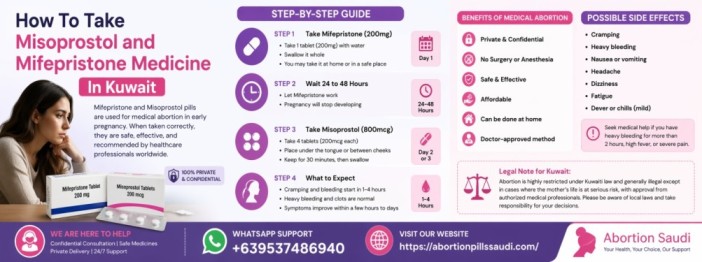
Method of taking misoprostol and mifepristone in Kuwait. Safe dosage, procedure, side effects, Frequently Asked Questions, and confidential help of Abortion Saudi. The stress of unplanned pregnancy can be high, particularly in the countries, which do not have access to reproductive healthcare. Lots of women in Kuwait seek the information on how to use misoprostol and mifepristone drugs safely and secretly. Mifepristone and Misoprostol in abortion are safe and globally accepted as long as the procedure is properly done in the early pregnancy.
This extended tutorial on how to use misoprostol and mifepristone pills in Kuwait, dosage, timing, side effects, aftercare, medical advice, and reliable medical resources.
Legal Disclaimer (Kuwait Law & Regulations)
This is purely an educational and informational article. According to the legislation of
Kuwait, abortion is significantly limited and is mostly illegal except in a few medical
cases where the life of the mother is in grave danger and it has to be granted by
certified doctors. Illegal abortion or that of the abortion-related drug could lead to a
sentence or fines according to the Kuwaiti Penal Code. It is highly recommended to
seek licensed medical professionals and comply with local legislation prior to making
any medical choice by women.
This information is not encouraging illegal actions and intended to foster healthy,
informed, and legal healthcare choices.
What are Mifepristone and Misoprostol?
Medical abortion is a procedure that is safe and is often employed; it uses two drugs Mifepristone and Misoprostol. All these drugs combine to terminate early pregnancy in an effective and natural manner without surgical intervention.
1. Mifepristone Abortion Medicine
Mifepristone is the initial drug used in a medical abortion. It operates by inhibiting progesterone which is a hormone that is necessary in sustaining pregnancy. In case of blocking progesterone, the uterine lining starts to degenerate and the pregnancy ceases to develop. The majority of women do not have severe symptoms when taking Mifepristone, some might feel some slight cramping or light bleeding.
2. Misoprostol Abortion Pills
Misoprostol is taken after Mifepristone. The said medication assists the uterus to contract and to force the pregnancy tissue to come out naturally. Women who have taken Misoprostol normally experience cramping and bleeding that is a sign that the abortion process has begun.
Mifepristone combined with Misoprostol is approximated to be 95-99 percent effective when used properly in an early pregnancy, usually between 10 and 12 weeks. Healthcare professionals highly recommend this method due to the fact that it is safe, private, and women can comfortably do the process at home under proper guidance.
Misoprostol and Mifepristone Medicine ( A-Z) How to Take it
Step 1: Confirm Pregnancy
Prior to taking abortion pills:
• Have a pregnancy test.
• Calculate weeks of pregnancy
• Check health conditions
• Consult a doctor, where possible.
Online confidential consultation is usually sought by women in Kuwait due to their privacy concerns.
Step 2: A First Take Mifepristone
Take:
• 1 tablet Mifepristone (200mg)
• Swallow with water
• Take at home or safe private place
After taking Mifepristone:
Most women are normal.
• A small amount of bleeding can take place.
• Pregnancy stops developing
Step 3: Wait and then take misoprostol
After taking Mifepristone:
• Wait 24–48 hours
• Then take Misoprostol
This is the waiting period during which Mifepristone will work.
Step 4: Take Misoprostol
Take:
• 4 tablets Misoprostol (200mcg each)
• Take under tongue or in inside cheeks.
• Allow to marinate 30 minutes.
• Swallow remaining fragments
After taking Misoprostol:
Onset of cramping occurs 1-4 hours later.
• Bleeding starts
Pregnancy tissue is spontaneously passed.
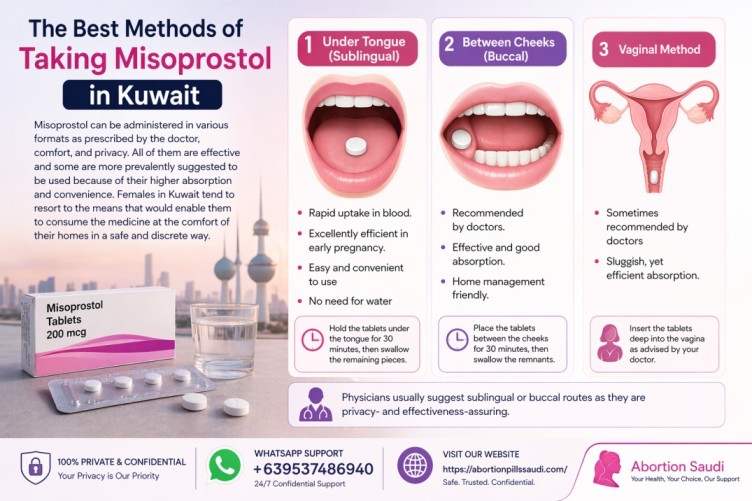
The Best Methods of taking Misoprostol in Kuwait
Misoprostol can be administered in various formats as prescribed by the doctor, comfort, and privacy. All of them are effective and some are more prevalently suggested to be used because of their higher absorption and convenience. Females in Kuwait tend to resort to the means that would enable them to consume the medicine at the comfort of their homes in a safe and discrete way.
Under Tongue (Sublingual)
• Rapid uptake in blood.
• Excellently efficient in early pregnancy.
• Easy and convenient to use
• No need for water
Between Cheeks (Buccal)
• Recommended by doctors.
• Effective and good absorption.
• Home management friendly.
Vaginal Method
• Sometimes recommended by doctors
• Sluggish, yet efficient absorption.
Physicians usually suggest sublingual or buccal routes as they are privacy- and effectiveness-assuring.
Expectations after taking Misoprostol
Following Misoprostol, the symptoms occur after women start having a contracting uterus, which expels pregnancy tissue. These are normal reactions, which show that the medicine is effective.
Common symptoms:
• Heavy bleeding
• Strong cramps
• Blood clots
• Nausea or vomiting
• Fever or chills
• Fatigue or weakness
These effects usually start in a couple of hours of ingesting Misoprostol.
Bleeding usually lasts:
• Heavy bleeding: 4–8 hours
Light bleeding or spotting: 1-2 weeks.
9 Side Effects of Mifepristone and Misoprostol
How to take misoprostol and mifepristone medicine should be used in the medical abortion and one should know about the side effects. The majority of the symptoms are normal and show that the medication is effective, yet others may need medical assistance.
1. Cramping
Misoprostol causes a lot of cramping. This occurs due to the contraction of the uterus in order to rid itself of the pregnancy. It might be helped by pain relievers, but not aspirin because this could make the person more likely to bleed.
2. Vaginal Bleeding
There is anticipation of bleeding that can be heavier than normal period. This may be blood clots and tissue. Light hemorrhage or spotting may go on aperiodically 1-2 weeks, or even a month.
3. Nausea
After using Misoprostol, some women feel nausea, weakness, vomiting or diarrhea. These symptoms tend to be temporary. In case they last longer than 24 hours, consult a doctor.
4. Fever or Chills
Temporary mild fever and chills can be experienced. Nevertheless, in case of fever exceeding 38°C or longer than 4 hours, seek medical attention.
5. Incomplete Abortion
The pregnancy might not be completely passed though it is rare. It is suggested that a follow-up should be made 1-2 weeks later to ensure success.
6. Heavy Bleeding
Normal heavy bleeding is okay but soaking two pads every hour of 2 hours is an emergency. Surgery can be required rarely.
7. Blood Clots
The passage of small clots is normal. Several hours of continuous clotting or big clots could necessitate health care.
8. Serious Infection
Continued pain, fever or ill-being more than 24 hours may be a sign of infection. Immediate medical care is important.
9. Severe Abdominal Pain
Ectopic pregnancy is a condition that can be manifested by severe or persistent pain and needs immediate treatment.
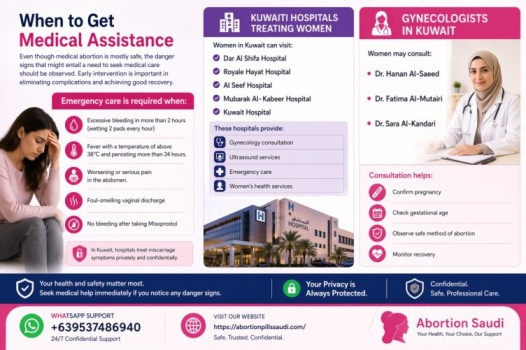
When to Get Medical Assistance
Even though medical abortion is mostly safe, the danger signs that might entail a need to seek medical care should be observed. Early intervention is important in eliminating complications and achieving good recovery.
Emergency care is required when:
• Excessive bleeding in more than 2 hours (wetting 2 pads every hour)
• Fever with a temperature of above 38C and persisting more than 24 hours.
• Worstening or serious pain in the abdomen.
• Foul-smelling vaginal discharge
• No bleeding after taking Misoprostol
In Kuwait, even, hospitals are going to treat miscarriage symptoms privately and confidentially.
Kuwaiti Hospitals treating women
Women in Kuwait can visit:
These hospitals provide:
• Gynecology consultation
• Ultrasound services
• Emergency care
• Women’s health services
Gynecologists in Kuwait
Women may consult:
• Dr. Hanan Al‑Saeed
• Dr. Fatima Al‑Mutairi
• Dr. Sara Al‑Kandari
Consultation helps:
• Confirm pregnancy
• Check gestational age
• observe safe method of abortion.
• Monitor recovery
Who should not take Abortion Pills?
Misuse of abortion pills should be avoided when:
• Ectopic pregnancy
• Allergy to medicines
• Chronic bleeding disorders
• Long-term steroid use
• IUD inside uterus
Always seek medical advice if unsure.
Aftercare After Medical Abortion
After abortion:
• Rest for 24 hours
• Drink fluids
• Use pain medication
• Avoid heavy work
• 1-week no sex.
Recovery usually takes:
• 1–3 days physical recovery
• 1–2 weeks bleeding
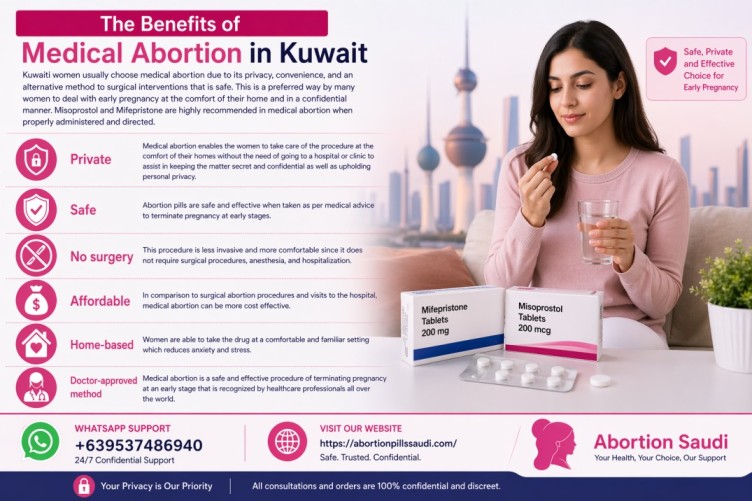
The benefits of Medical Abortion in Kuwait
Kuwaiti women usually choose medical abortion due to its privacy, convenience, and an alternative method to surgical interventions that is safe. This is a preferred way by many women to deal with early pregnancy at the comfort of their home and in a confidential manner. Misoprostol and Mifepristone are highly recommended in medical abortion when properly administered and directed.
The advantage of this is that women like this way because:
• Private
Medical abortion enables the women to take care of the procedure at the comfort of their homes without the need of going to a hospital or clinic to assist in keeping the matter secret and confidential as well as upholding personal privacy.
• Safe
Abortion pills are safe and effective when taken as per medical advice to terminate pregnancy at early stages.
• No surgery
This procedure is less invasive and more comfortable since it does not require surgical procedures, anesthesia, and hospitalization.
• Affordable
In comparison to surgical abortion procedures and visits to the hospital, medical abortion can be more cost effective.
• Home-based
Women are able to take the drug at a comfortable and familiar setting which reduces anxiety and stress.
• Doctor-approved method
Medical abortion is a safe and effective procedure of terminating pregnancy at an early stage that is recognized by healthcare professionals all over the world.
Abo Abortion Saudi For Abortion Support
Business Name: Abortion Saudi.
Website: https://abortionpillssaudi.com/
Phone: +639537486940
Abortion Saudi provides:
• Confidential consultation
• Safe abortion pills
• Private delivery
• Step-by-step guidance
In Kuwait, women prefer Abortion Saudi because of its privacy and reliable medication.
Misoprostol and Mifepristone medicine: How to Take, FAQ
1. Which one is to be taken initially between mifepristone and misoprostol?
Use Mifepristone initially then Misoprostol after 24-48 hours. This guarantees safe and effective abortion.
2. How to take misoprostol most effectively?
The best practices:
• Under the tongue
• Between cheeks
These techniques are more absorbent.
3. Which misoprostol to use 2 or 4?
Typically:
• Take 4 tablets Misoprostol
• Each tablet 200mcg
• Total dose: 800mcg
Doctor guidance recommended.
4. Do you have to wait 24 hours after taking mifepristone to take misoprostol?
Yes. Wait 24–48 hours after taking Mifepristone before taking Misoprostol.
5. How long does bleeding last after misoprostol?
• Heavy bleeding: 4–8 hours
• Light bleeding: 2 weeks or less.
This is normal.
6. Is it safe to medically abort?
Yes, medical abortion is safe when:
• Used correctly
• Within early pregnancy
• Proper instructions followed
7. The effectiveness of misoprostol and mifepristone?
Effectiveness:
• 95–99% successful
• Works best in 10 weeks.
8. Am I allowed to take abortion pills at home?
Yes. A significant number of women do so without risk and safely, with instructions on abortion pills at home.
9. What is the periodicity of pregnancy test?
Take pregnancy test:
• After 3–4 weeks
• To verify success of abortion.
10. Will abortion mean that I can no longer get pregnant?
Yes. Fertility returns quickly:
Ovulation can take place in a 2-week period.
• Be contraceptively safe.
Final Thoughts
Learning about how to administer misoprostol and mifepristone medicine in Kuwait will enable women to make informed decisions in a safe manner. When properly used, medical abortion is a safe, private, and effective option.
In case of confidential consultation and safe medication you need:
Website: https://abortionpillssaudi.com/
WhatsApp: +639537486940
Professional care, privacy, and safe care – accessible to women of Kuwait.